2023
Development of innovative Virtual Reality technologies for foreign  language learning.
2023-1-HR01-KA220-ADU-000151917

Project description

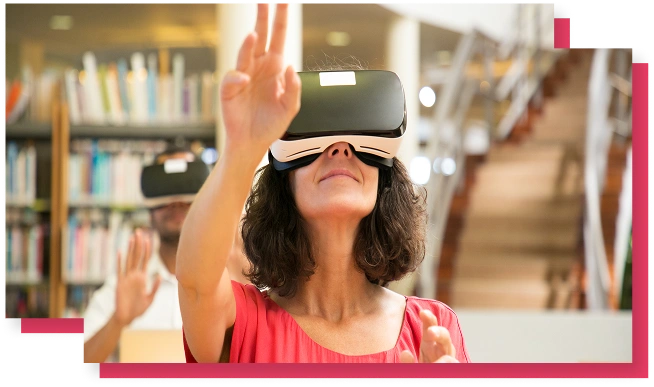
Our original project, VR4LL 1.0, provided language teachers and learners with the opportunity to use VR technology in a classroom context. One student wearing a headset was given a task to complete in one of our engaging virtual worlds, with instructions being provided by his or her classmates. The success of this initial project can be measured by the large number of language schools that are using our VR materials, and by the fact that the project was shortlisted for the British Council’s prestigious ELTon’s award, in the category of Digital Innovation.

VR4LL 2.0 is a new project, also co-funded by Erasmus+, that has even more ambitious aims. In this new project we will develop two different types of learning environment. In the first type, students will be asked to perform tasks in a virtual learning environment such as a science lab, which may be familiar to some students, but certainly won’t be familiar to all of them. In the second type of environment, students will have to complete a task by navigating their way around a series of virtual escape rooms. In this case, nothing will be quite so familiar; neither the virtual environments themselves, nor the sort of activities students are required to undertake.

Both types of learning environment will allow multiple players, so students will be able to interact with their classmates both inside and outside the virtual worlds, as well as with a wide range of objects and avatars (or non-playable characters).The underlying aim of VR4LL 2.0 is to leverage recent advances in VR technology to provide students with even more stimulating opportunities to practice and improve their language skills.


Activities

1st transnational meeting
Split, Croatia
Dates:29/11/2023 - 01/12/2023
Host: Učilište Jantar
Our first live meeting took place in Split, attended by all partners. As it is a large project, our meeting lasted for three days during which we reached numerous conclusions and agreed upon future activities. We established tools for project management, thoroughly reviewed the timeline of our project, and carefully crafted our quality control criteria and impact plan. Additionally, we engaged in detailed discussions regarding the concept of our virtual learning environments and we are now ready to start developing them.
Second transnational project meeting
Pisa, Italy
Dates:26/06/2024 - 27/06/2024
Host: British School Pisa
This meeting focused on transitioning from conceptual design to VR development. Partners reviewed progress on the three virtual learning environments (VLEs), confirming learning outcomes, conceptual designs, and software specifications. VLE1 (Scientific Laboratory) was demonstrated and tested on the Oculus Quest 3, with activities such as molecule building, bacterial growth, and flame interaction finalized. Designs for VLE2 (Restaurant) and VLE3 (Natural Environment) were also outlined, including interactive tasks and AI-powered NPCs. The team also reviewed progress on virtual escape rooms (VR1 “Game of Phones” and VR2 “Mystery”).
Third transnational project meeting
Barcelona, Spain
Dates:06/03/2025 - 07/03/2025
Host: Moheill Holdings
The meeting in Pisa focused on reviewing the first periodic report and coordinating progress on work packages. Partners agreed on upcoming technical tasks and deadlines, including finalizing scripts and visual content for VLE2 and VLE3, improving the teacher training toolkit, and planning for the piloting phase.
Generic selectors
Exact matches only
Search in title
Search in content
Post Type Selectors
Generic selectors
Exact matches only
Search in title
Search in content
Post Type Selectors